GA4 said traffic had collapsed. Orders said otherwise.
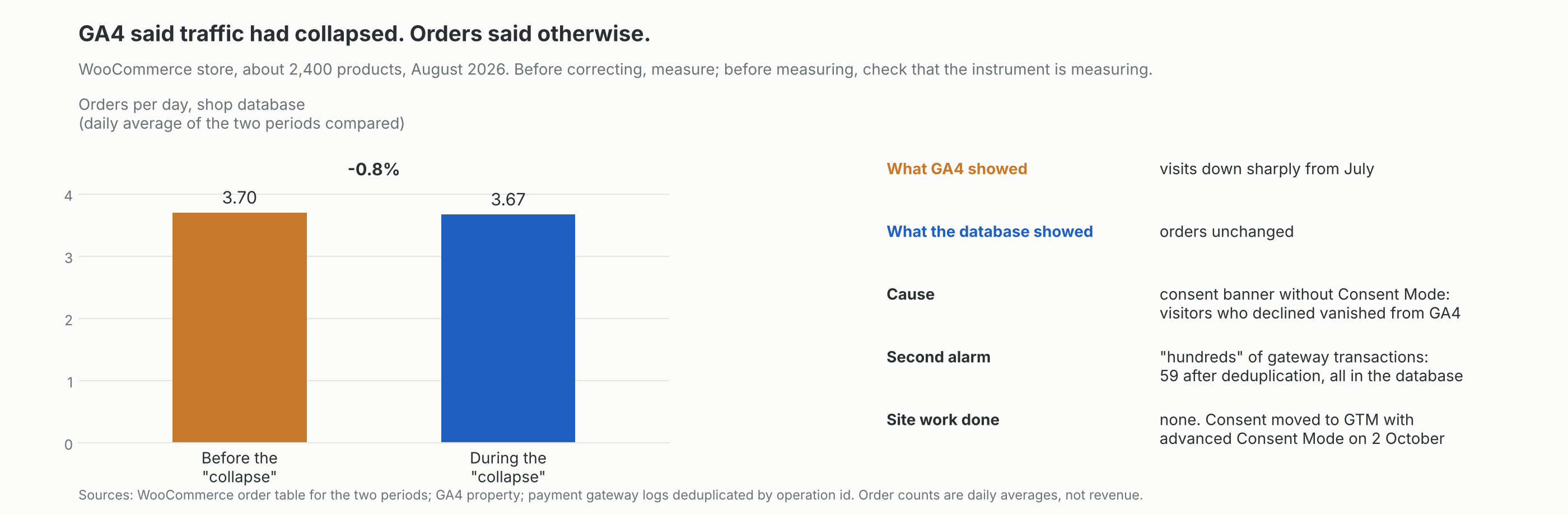
In August 2026 the owner of an Italian WooCommerce store, about 2,400 products, called with a clear request: visits in Google Analytics had collapsed in July, something must be broken, fix the site.
Before touching anything I checked the one number that does not depend on analytics: orders in the WooCommerce database. They were stable, 3.67 a day in the period of the supposed collapse against 3.70 a day before it. A site that loses most of its visitors does not keep selling at the same rate. So either the orders were wrong or the visits were.
The visits were. The consent banner had been reconfigured without Consent Mode. Every visitor who declined cookies, which on an Italian retail site is most of them, simply disappeared from GA4: no event, no session, no pageview. The denominator had been amputated, not the traffic. The site had not changed; the measurement had.
A second alarm arrived in the same weeks: the payment gateway’s logs seemed to show hundreds of transactions that were not in the shop, which to the owner looked like lost or phantom orders. Deduplicated by operation identifier, the log entries were 59, and every one of them was present in the WooCommerce database. The gateway repeated the full history on every response. Zero phantom orders, zero missing revenue.
Instead of “fixing the site”, the consent banner moved to Google Tag Manager with advanced Consent Mode on 2 October. Declining visitors now send anonymous, cookieless pings that let GA4 model them without identifying them; accepting visitors are tracked as before; the banner plugin left the PHP stack, saving 0.04 s per page. The owner now has a traffic series that can be compared month to month, which he did not have before.
Why it matters
The most expensive thing a consultant can do is work on the problem the client describes instead of the one the data shows. Here the described problem would have meant days of performance and SEO work on a site that had nothing wrong with it. Before correcting, measure; before measuring, check that the instrument is measuring.
Limits
Order counts are from the shop database for the two periods compared and are stated as daily averages; they say nothing about revenue. The GA4 series before 2 October remains unusable for comparison and is documented as such.
Anonymised at the client’s request.